

Just got off a coaching call with a designer.
Talented. Solid portfolio. Couldn’t land interviews to save her life.
I dived deeper with her and realised that there’re three blindsides she’s made.
These matters ALMOST more than design work at the interview stage.
Yet, most designers don’t even realise they’re making these mistakes.
It’s portfolio prepping and self reflection season (the holidays), I want to take this blog opportunity to address these three things: Time management. Preparation. Articulation.
Hot off the press.
⏰ Read time: 4 mins
Hi I’m Jac. I’m a Product Design Leader and a Business Design Coach. I’ve been teaching designers to be more strategic since 2018. Here you can find my reflections, observations and learnings about design, inspirations, communication and making strategic decisions.
Thanks for reading my thoughts today ☺️. Subscribe to stay in touch.
Before we begin. Let me put this out there: Didn’t pass an interview doesn’t mean it’s always on you. It could be unpredictable shifts that’s out of your control: Financial decision shift, hiring priority shifts at the company.
But it’s on you, if you did any of these three things:
👇🏽👇🏽👇🏽
Interview blindside #1:
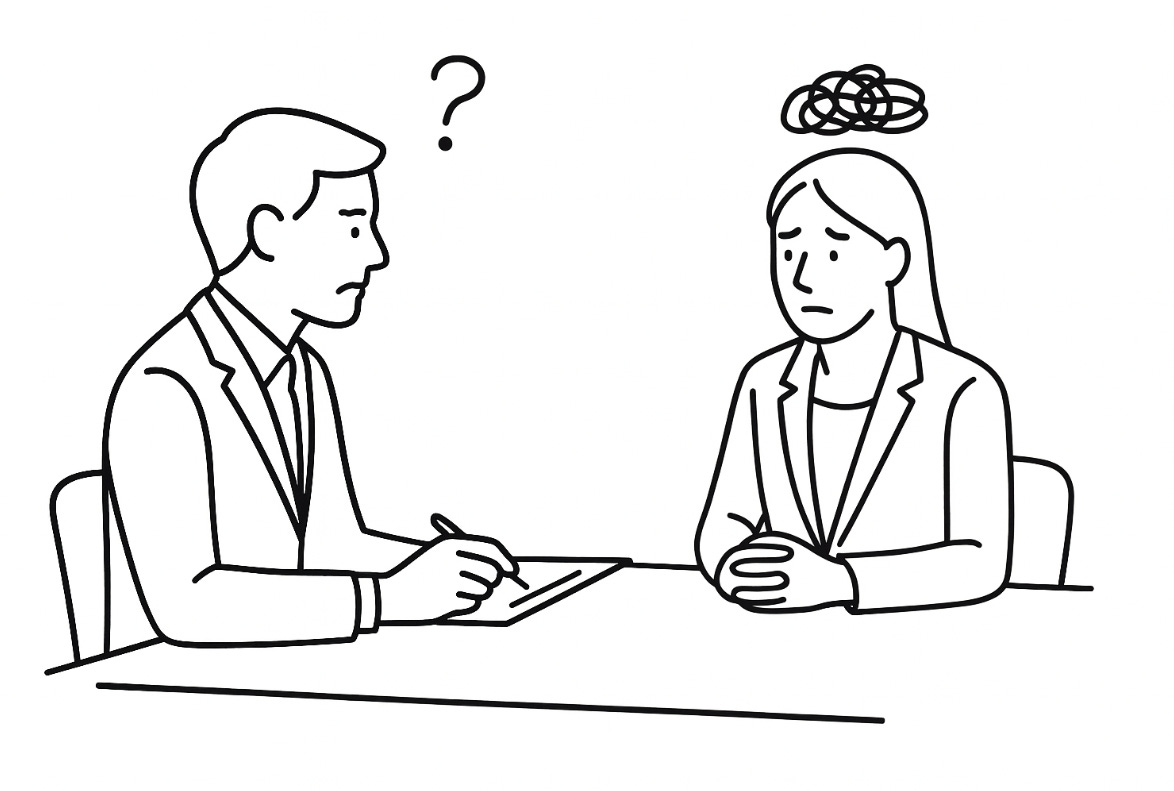
Too much details. Not enough time management. 🫣
Here’s what happens:
You get 30 minutes for your case study presentation.
You dive deep. Every research finding, every iteration, every stakeholder conversation.
25 minutes later, you’re still talking.
The interviewer is checking their watch.
By this point, it’s already too late.
You’ve left zero time for the actual interview: the conversation where they assess whether you can share just enough context with good time management.
It doesn’t matter how complex your project is, the crucial part is: Your decision on how much to share to get enough context across - This separates the strategic thinkers and the talkers.
Do this next time:
Consider the 30mins interviews in 4 chunks: 5-15-5-5
First 5 mins to get to know you and the company.
15 minutes max for your case study. That’s it.
5-10 minutes for the interviewers to ask you questions
and the remaining 5 mins for you: Come prepared with 1-2 thoughtful questions to ask them.
—
Interview blindside #2:
You skipped the research 🧐
“It’s just a small startup. I don’t need to research them deeply.”
Wrong.
Your lack of preparation shows the second you start speaking.
When you haven’t researched their business, product, and team...
You give generic answers.
They want tailored solutions.
They’re looking for designers who think strategically and understand their specific context because businesses would be taking a risk to hire one type of designer for all types of needs.
So, before every interview:
Study their product, business models
Read recent announcements
Understand company maturity and market position
Research who you’re meeting - if you have 5 rounds of interviews, do the research every single round.
Then draw parallels in your case study presentation.
Show how your approach adapts to their technology capabilities and company stage.
Make it about them, not you.
—
Interview blindside #3:
The Data Excuse (the biggest killer) 😭
“The previous company didn’t track data, so I don’t have metrics.”
I hear this constantly.
Here’s what that tells interviewers:
You don’t know how to measure impact.
You don’t know if the solution going out the door is wasting everyone’s time.
Your previous company’s lack of data maturity doesn’t mean you lack the knowledge.
You can still show them that you know:
What metric the project impacted
The minimum validation you did (even getting validations from internal colleagues or social listening)
How you knew it worked or didn’t work after it rolls out
So what can you do when you don’t have enough data for your project?
The surprising truth for many is: You don’t need the perfect data.
But you must learn how to articulate your thinking:
Can you explain what success looked like?
Do you have user frustration data, industry trends, decision rationale?
Did this project generated impacts beyond product?
When you come across blockers and challenges, what did you do to overcome?
What would you have done differently?
Show your decision-making process, not rigid frameworks. (Frameworks are there to help you think - your audience is more interested to know what you got out as a result)
Connect your design work to business benefits: beyond product, users, revenue. Think operation, time to market, team culture.
—
Many designers came to my course struggle with these:
“I don’t know how to connect design to business outcomes.”
“I am not confident to validate design opportunities.”
“I can’t articulate the business benefits of my work.”
This are the exact pain points I help with in Strategic Design Career Accelerator
With the growth of AI replacing repetitive craft skills, now it’s the time to become the strategic creative orchestrator every organisation needs.
Master business strategy decision making as a designer.
Learn to connect designs to measurable business outcomes.
Apply proven frameworks for compelling interview storytelling.
You have so much more to offer than being another designer with a nice looking portfolio.
Next cohort: February 2026.
Take 25% OFF - One week only Nov 17-24
Code: FAST25
FYI:
My teaching styles are:
Straight up. Never just share slides. Hands on practise is key. Unlimited 1-1s. Humour and optimistic. Sometimes overshare.
😍 Here are some solid outcomes from Oct cohort:
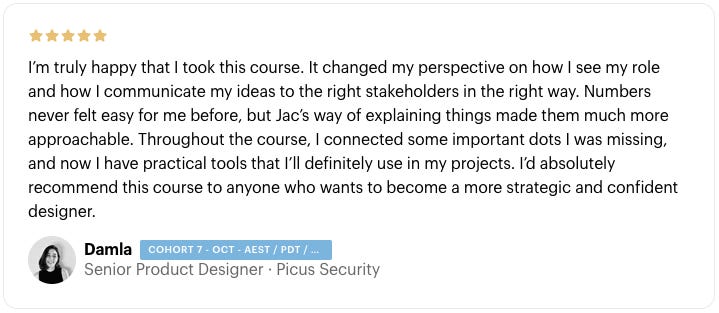
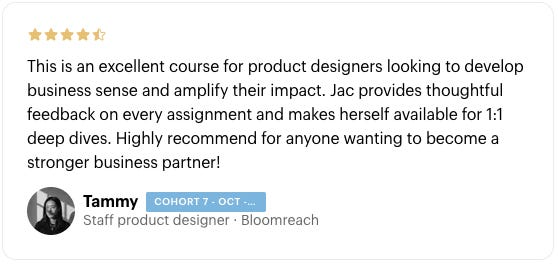
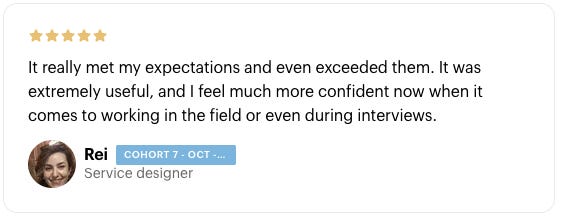
If you’re not sure if this course will suit your growth, feel free to book a call with me.